

Why Smokey Jollof Tastes Different From Regular Jollof Rice
Ask a Nigerian to name the best jollof rice they’ve ever eaten, and almost nobody says “the one I made at home.” They name a wedding. A birthday party in 2016. That one caterer from Mushin their aunty keeps calling. The jollof rice people remember wasn’t cooked on gas in a standard pot, and there’s a real technical reason for that.
Here’s what’s actually different.
The cooking method is the flavour
Gas-stove jollof is how most households cook rice. You build a tomato base, add seasoning, add the rice, cover the pot, and let it steam until done. Nothing wrong with it. Plenty of Lagos eats very good jollof this way every evening.
Party jollof is a different process. The cooking happens over firewood in a wide, shallow iron pot, and the rice at the bottom of that pot is supposed to char. Not burn, char. There’s a real difference. A light, controlled scorch on the bottom layer creates a slightly toasted, slightly bitter, smoky note that then gets distributed through the whole pot when the cook turns the rice at the end. That redistribution is why every spoonful tastes different from gas-stove jollof, not just the bottom few bites.
That toasted layer at the base of the pot is what older Yoruba kitchens call “the bottom pot.” Lagos caterers fight over who gets it when the pot is empty. If you’ve been at a party where two aunties were quietly negotiating over the bottom of the jollof pot while the DJ played Afrobeats, you already know exactly what we’re talking about.
Why the smoke doesn’t come from the ingredients
People sometimes assume the smoky flavour comes from a spice or a seasoning blend, something they could add to their home pot and get the same result. It doesn’t. The smoke comes from the wood burning underneath, and the char comes from sustained, high heat at the base of the pot that a gas burner can’t quite replicate at home.
A regular gas hob doesn’t get the floor of the pot hot enough to char rice cleanly without also overcooking everything above it. Firewood and charcoal burn broader and hotter, which is why the rice can take on that deep colour at the bottom while the top layers stay cooked properly. The pot shape matters too, the wide, shallow party pot spreads the rice thin enough that the heat reaches it evenly. A tall, narrow home pot piles the rice too deep for any of this to work right.
Which is why home cooks who try to recreate party jollof on gas usually end up with either rice that’s slightly burnt but not properly smoky, or regular jollof that tastes fine but doesn’t quite have that thing. The method isn’t just a tradition. It’s what makes the flavour.
What our kitchen does differently
We cook our jollof over firewood, every batch, every day. We run a dedicated firewood setup outside the main kitchen with the right pots for the volume we cook. One person manages the fire and the wood supply specifically so the temperature stays where it needs to be throughout the cook.
We throw out the occasional batch when the timing slips, because the char window is short and there’s no recovering a pot that went wrong. It’s a cost we accepted when we set up the kitchen this way, and we think it’s the right call. The alternative is putting a gas-stove version on the menu and calling it the same thing, and we didn’t want to be one more place doing that.
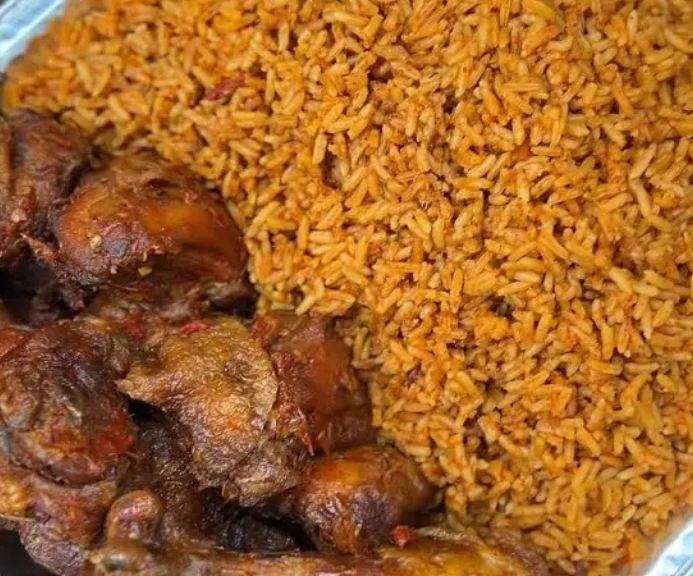
When the jollof is right, three things tell you before you’ve taken a bite: the colour is a deeper orange-brown than gas-stove jollof (the char underneath affects the whole pot’s colour), the smell reaches you before the plate does, and you’ll find darker bits of rice mixed through the bowl, those are from the bottom layer, redistributed. Some customers ask us specifically for extra of those bits. We understand completely.
What makes the difference at a party
There’s also a scale factor worth mentioning. At a proper owambe, the pot is cooking for a hundred or two hundred people, and the fire burns for a long time at high intensity. That sustained heat over a long cook is part of why event jollof has a depth that a home pot of jollof for six people can’t replicate even if you try the same technique. The science is simple: longer cook at higher heat over wood means more char, more smoke distribution, and a richer flavour overall.
This is also why restaurant versions tend to fall flat. Most commercial kitchens are built for gas and speed. Firewood is slow, it’s unpredictable, and it needs physical space outside the kitchen for safety. The economics push almost every restaurant toward gas-stove jollof, which looks the same in photos but doesn’t taste the same on the plate.
Why it’s worth tasting once
If you grew up going to Nigerian celebrations, the flavour we’re describing is already in your memory. It’s the jollof that made you go back for thirds at your cousin’s wedding. The one you were still thinking about on Monday.
If you haven’t had the firewood version before, it’s one of those things that’s much easier to settle by tasting than by reading. Order a bowl, eat it while it’s still hot (the smoky note is most obvious in the first ten minutes), and you’ll have a clear sense of what all the arguing is about. Our smokey jollof rice is available to order for delivery across Lagos, solo portions, larger packs for sharing, or paired with asun if you want the peppered goat meat alongside it.
We’re at 11A Oguntona Crescent, Pedro, off Gbagada Expressway, and we’re open Monday to Friday from 7am to 3pm and Saturday to Sunday from 8am to 3pm.